Rivers Never Dry

Location
London, United Kingdom
Year
2026
Type
Personal
London's rapid urbanisation during the Industrial Revolution buried many of its rivers underground. Repurposed as sewers and erased from the surface, these waterways disappeared from sight yet continued to persist through ecology, infrastructure, and spatial memory.
Tracing the River Effra, which was culverted in the mid-nineteenth century like other lost rivers, I encountered multiple traces of its former presence: parks occupying land too damp for habitation, willow and alder trees quietly marking the former channel, buildings conspicuously avoiding the buried riverbed, stink pipes emerging awkwardly between roads and buildings. Though invisible, the river remained everywhere, a latent system continuing to shape and influence the city above it.
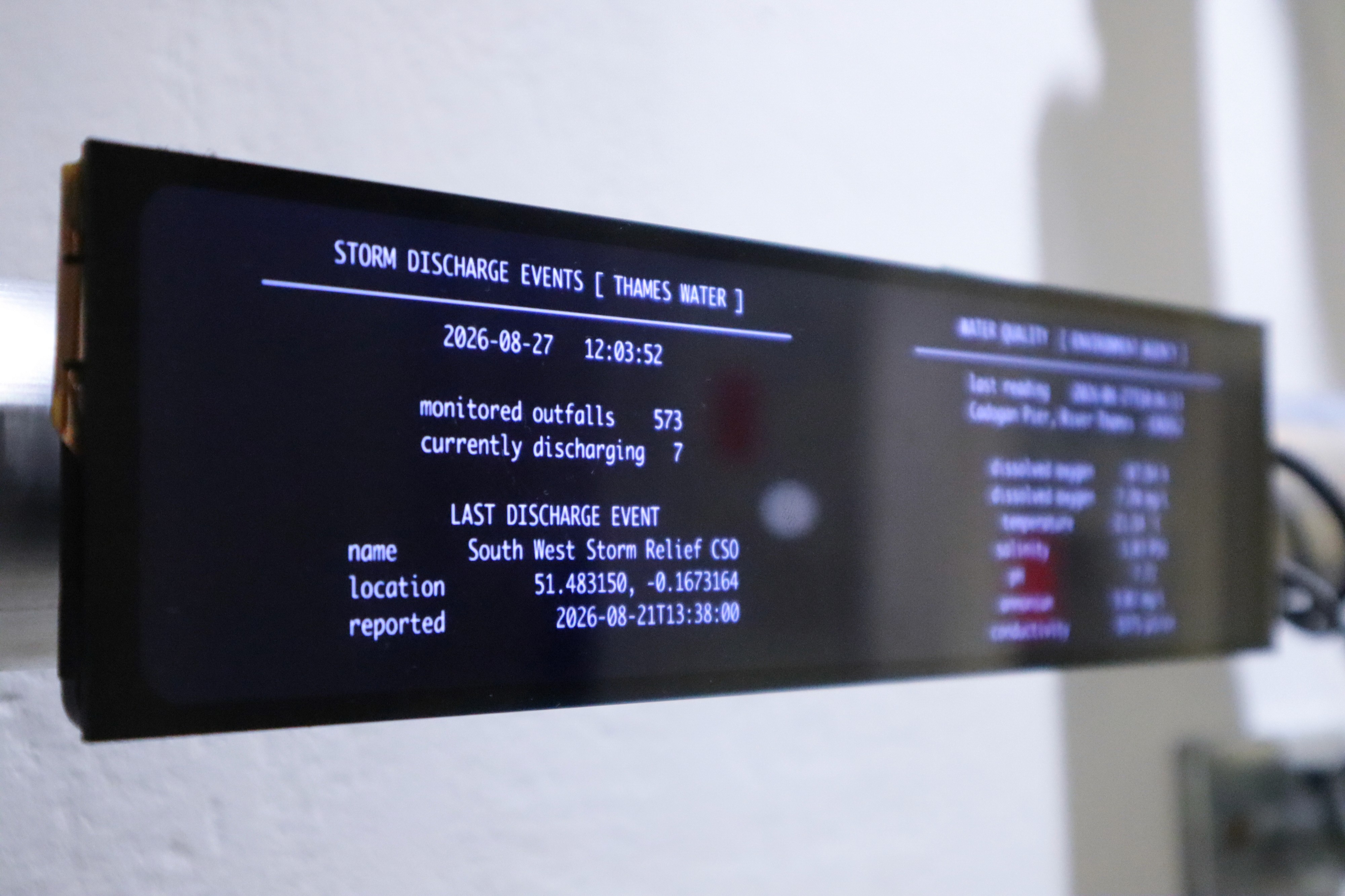
Since 2022, Thames Water has made real-time storm discharge data publicly accessible via an API. The river, buried and transformed into infrastructure, now also persists as a data stream. This raises a critical question: what does this data represent beyond its informational function? What meanings are embedded within it?
Rivers Never Dry investigates the hidden existence of buried urban waterways as entangled ecological, political, infrastructural, and computational systems. Through field research, speculative visualisation, and data-driven artistic practice, the project examines how rivers continue to exist despite physical erasure, and how data itself may carry residual memory.
This project was published as part of the student publication journals, The Computational Arts Critical Papers: f0rm1ess. Free PDF version can be access at Goldsmiths Research Online (https://research.gold.ac.uk/id/eprint/40726/).